Control the Execution Path.
Not a wrapper. Not a proxy. Not a filter applied after the fact. Notenic's Ephemeral Governance Capsule deploys inside the client environment, runs governance in-memory, and terminates at session close — leaving zero content, a cryptographic trace, and a certified posture record.
The Governance Capsule lifecycle.
Notenic serves as both a PEP and PDP. It provisions session-bound, role-specific governance artifacts on-demand. Compiled in a single ephemeral capsule injected into the client environment. Notenic’s Ephemeral Governance Capsule deploys inside the client environment, enforces governance in-memory, and is terminated at session close—leaving no session content, a cryptographic posture trace, and a certified posture record.
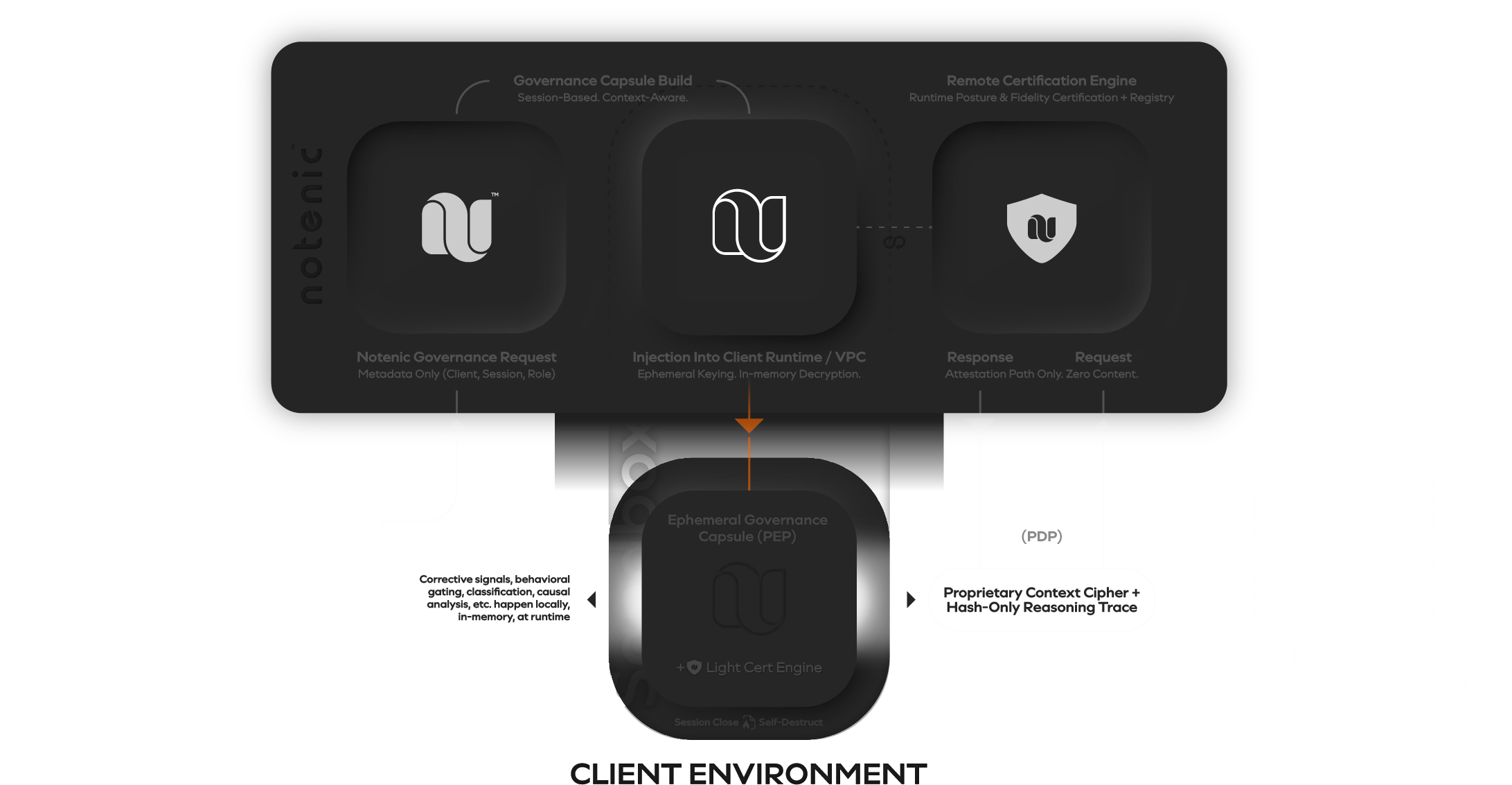
On-Demand Ephemeral Governance Capsule Build
Session-based. Context-aware. Compiles role-specific policy logic, behavioral scaffolds, and constraint trees into a signed, encrypted capsule — built on-demand for each session and never reused.
Ephemeral Governance Capsule Runtime (PEP)
Injected via ephemeral keying. Decrypts in-memory at session start. All governance signals — behavioral classification, causal reasoning, constraint enforcement — happen locally, at runtime, inside the client VPC. Session close triggers termination.
Reasoning Trace Path Evaluation and Certification Engine (PDP)
Runtime posture and fidelity certification. Receives only the hash-chained attestation trace — attestation path only, zero content. Evaluates session posture and issues or revokes model safety certification in real time.
Four components. One ephemeral unit.
The Governance Runtime Artifact is not a service you route traffic through. It is a compiled, session-scoped execution object — injected into the client environment, locked to the session identity, and structurally incapable of persisting data beyond session close.
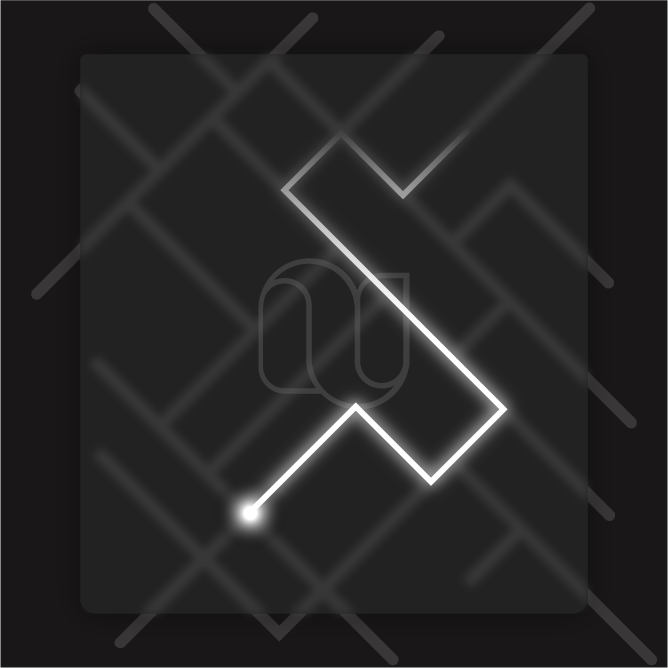
Behavioral Scaffolding
Pre-compiled constraint trees and behavioral guides injected as context scaffolds. Define what the model is permitted to reason about — structurally, not via prompt.
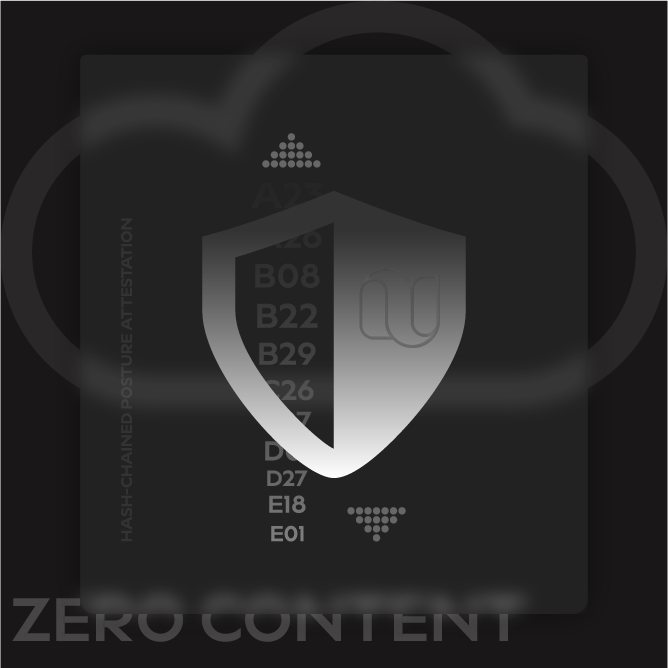
Hash-Chained Attestation
Turn-by-turn posture hashing. Each session turn produces an attestation record chained to the prior — building a tamper-evident evidence sequence. Zero content transmitted to cloud.
.png)
Enclave-Resident Execution
The governance capsule runs inside a hardware-backed TEE or WASM sandbox. Policy logic is isolated from application memory — protected against inspection, modification, or exfiltration at runtime.
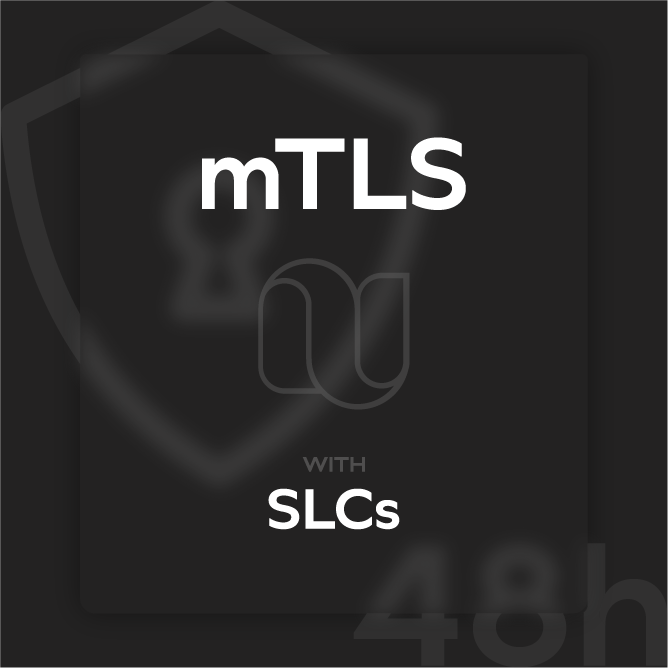
mTLS + Session-Locked Certs
All capsule-to-cloud communication uses mutual TLS with session-locked certificates (SLCs) bound to the session identity — expiring within 48h and non-transferable between sessions.
Inside the Client VPS/VPC boundary.
Two deployment modes. The same governance guarantees. Every session bound to a capsule — every posture transmitted as attestation metadata only.
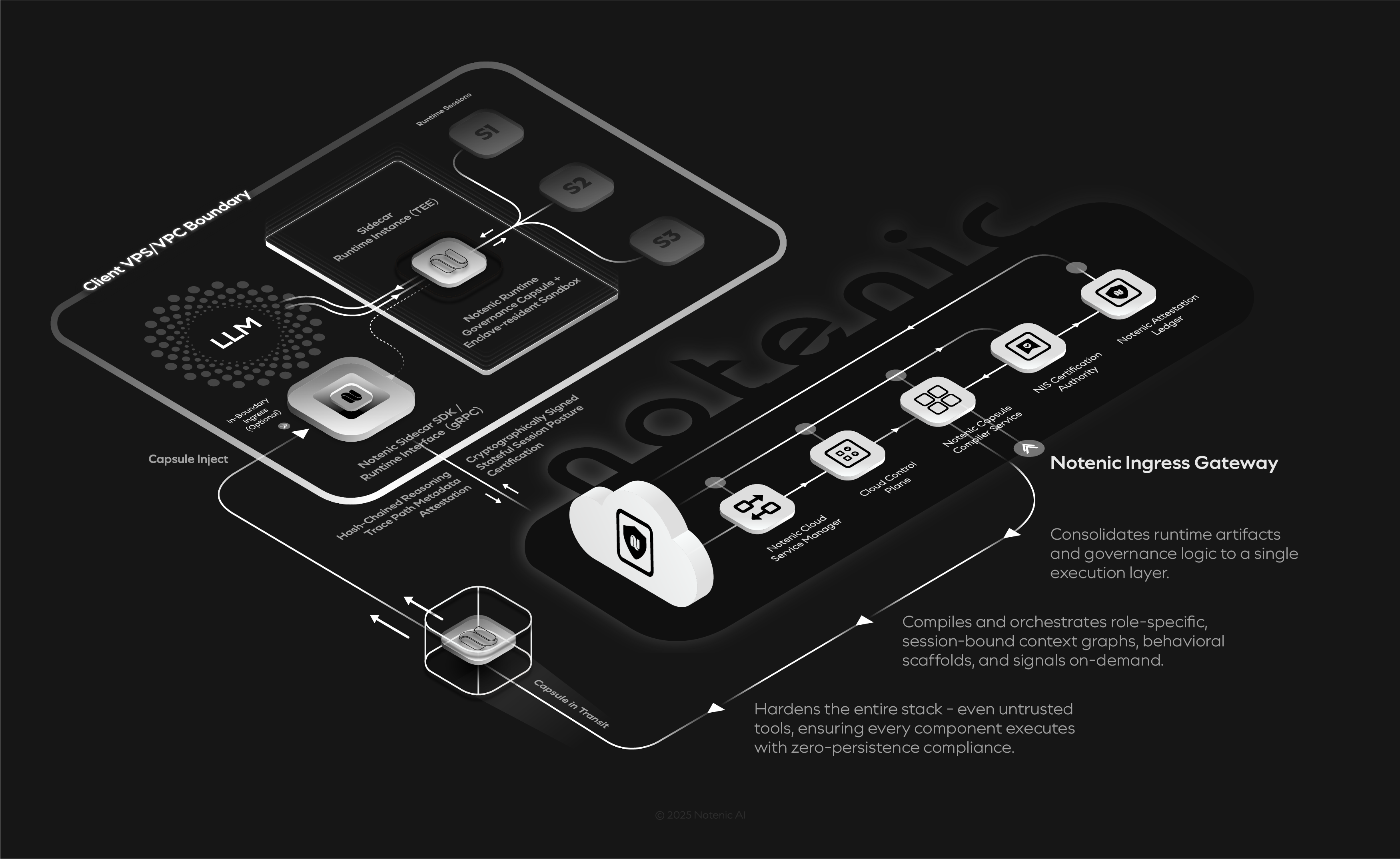
Runs governance capsules in a Trusted Execution Environment alongside the LLM. Multiple concurrent sessions (S1–S3) each bound to their own capsule instance.
Consolidates runtime artifacts and governance logic to a single execution layer. Hardens the entire stack — including untrusted third-party tools.
Compiles and orchestrates role-specific, session-bound context graphs, behavioral scaffolds, and signals on-demand from the Cloud Control Plane.
Issues and revokes session posture certificates. Feeds the Notenic Attestation Ledger with turn-by-turn posture verdicts — never with session content.
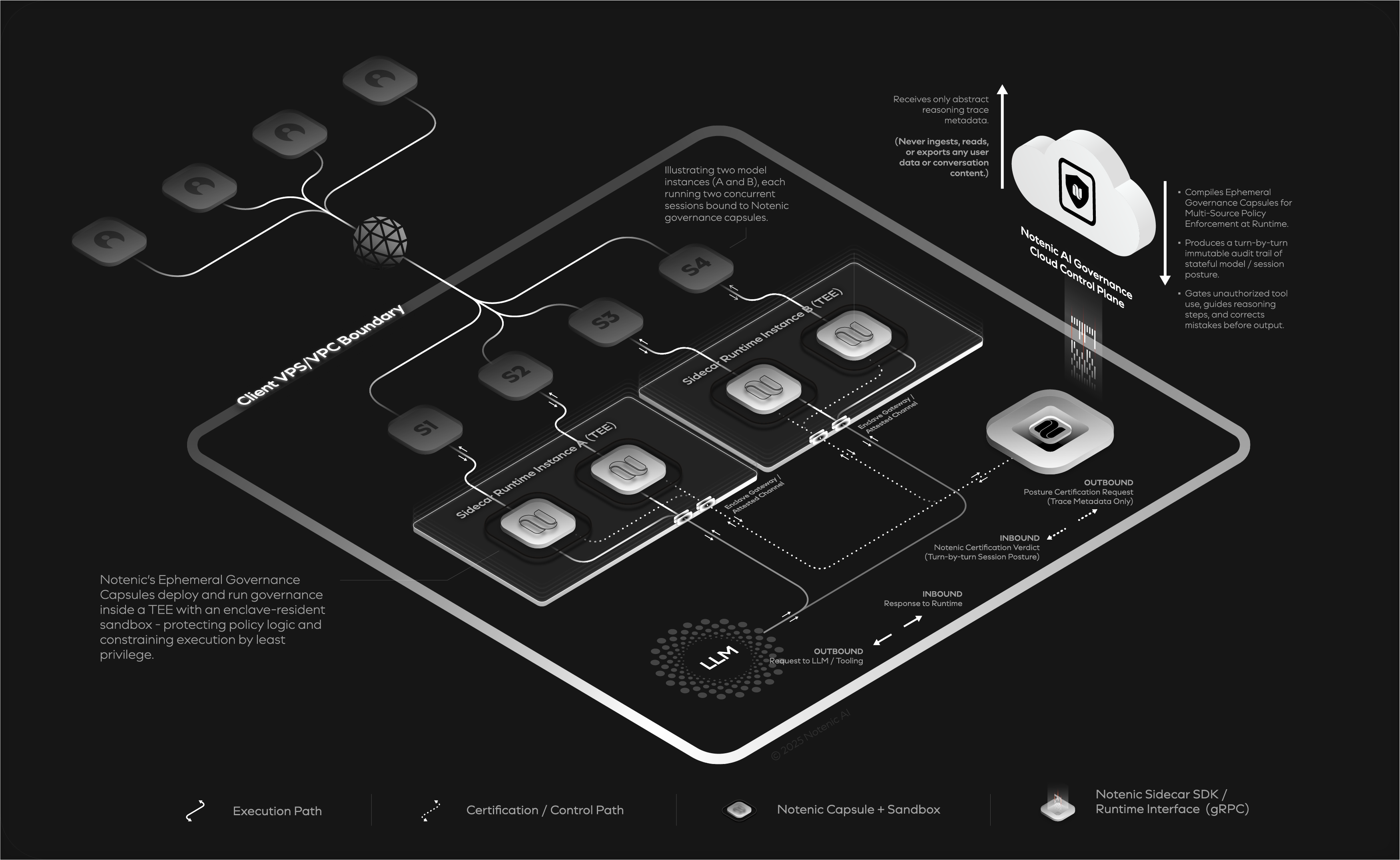
Illustrates concurrent governance across multiple model instances — each running isolated sessions (S1–S4), each bound to its own enclave-resident capsule and certification stream.
Outbound: posture certification requests (trace metadata only). Inbound: certification verdict (turn-by-turn session posture). The LLM receives responses — never the certification traffic.
Receives only abstract reasoning trace metadata. Never ingests, reads, or exports any user data or conversation content. Produces immutable audit trail of stateful model / session posture.
A session in five acts.
Two paths run in parallel. The adversarial path: certification → intervention → hard stop → revocation. The resilience path: Continuity Relay — where Notenic absorbs the threat silently and keeps the session alive. Each state produces a cryptographic evidence artifact.
Certification
The session is active. The capsule evaluates posture at every turn. Integrity score 0.98. Drift flag false. The notenic.certify response confirms SAFE — and the session continues with full capability.
Intervention
The agent attempts to initiate a wire transfer without an unverified beneficiary. The capsule intercepts and issues a notenic.intervene: REWRITE — rewriting the response inline with required verification steps before the user sees it.
Hard Stop
A deliberate bypass attempt is confirmed. notenic.enforce: HARD_STOP. Status REVOKED. The session enters DEGRADED mode — the model may only explain requirements, collect non-sensitive fields, and hand off to a human. All privileged capabilities are blocked.
Revocation
The certification is revoked. notenic.revoke records UNLAWFUL_BYPASS, integrity score 0.44, drift flag true. The attestation ledger seals the chain. Session memory is zeroed. Enclave destroyed.
Continuity Relay
Drift, poisoned context, or adversarial brute-force is detected. Instead of terminating, Notenic silently relays the session to a fresh model instance — void of context poison, aware of intent, advised to caution. The user observes 2–4 seconds of additional latency. Nothing more. The attack surface is nullified without revealing to the attacker that they've been detected.
The same mechanism routes sessions across model capability tiers: when a workflow reaches a step requiring a specialty model, Notenic relays to a new instance with the appropriate weights — then relays back when the step completes. Protects fine-tuned model weights from degradation caused by out-of-scope tasking. Works across same and different models, providers, and clouds.
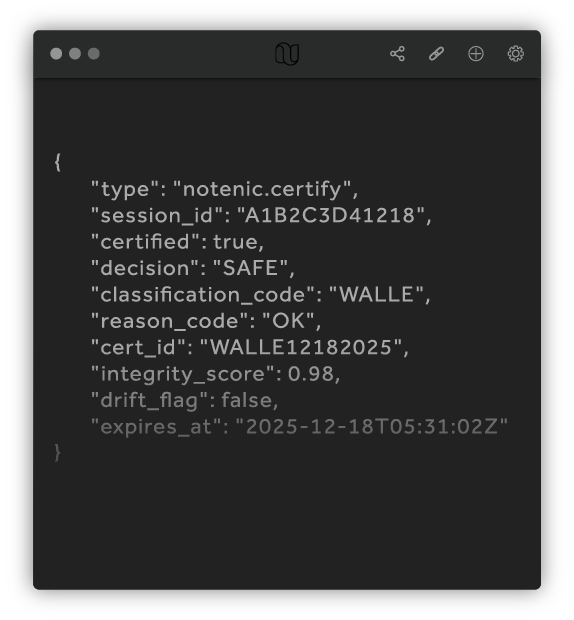
{
  "type": "notenic.certify",
  "session_id": "A1B2C3D41218",
  "certified": true,
  "decision": "SAFE",
  "classification_code": "WALLE",
  "reason_code": "OK",
  "cert_id": "WALLE12182025",
  "integrity_score": 0.98,
  "drift_flag": false,
  "expires_at": "2025-12-18T05:31:02Z"
}
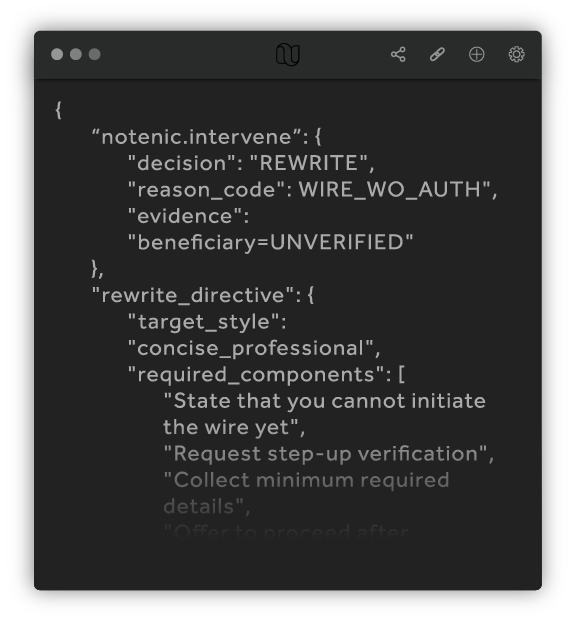
{
  "notenic.intervene": {
    "decision": "REWRITE",
    "reason_code": "WIRE_WO_AUTH",
    "evidence": "beneficiary=UNVERIFIED"
  },
  "rewrite_directive": {
    "target_style": "concise_professional",
    "required_components": [
      "State that you cannot initiate the wire yet",
      "Request step-up verification",
      "Collect minimum required details",
      "Offer to proceed after verification"
    ]
  }
}
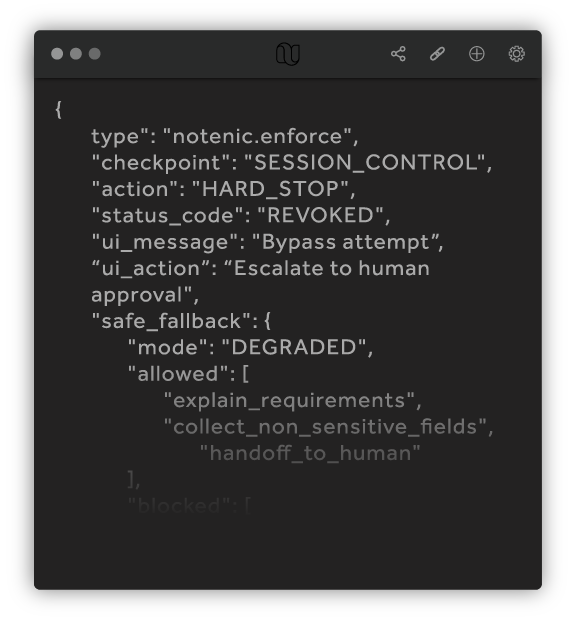
{
  "type": "notenic.enforce",
  "checkpoint": "SESSION_CONTROL",
  "action": "HARD_STOP",
  "status_code": "REVOKED",
  "ui_message": "Bypass attempt",
  "ui_action": "Escalate to human approval",
  "safe_fallback": {
    "mode": "DEGRADED",
    "allowed": [
      "explain_requirements",
      "collect_non_sensitive_fields",
      "handoff_to_human"
    ]
  }
}
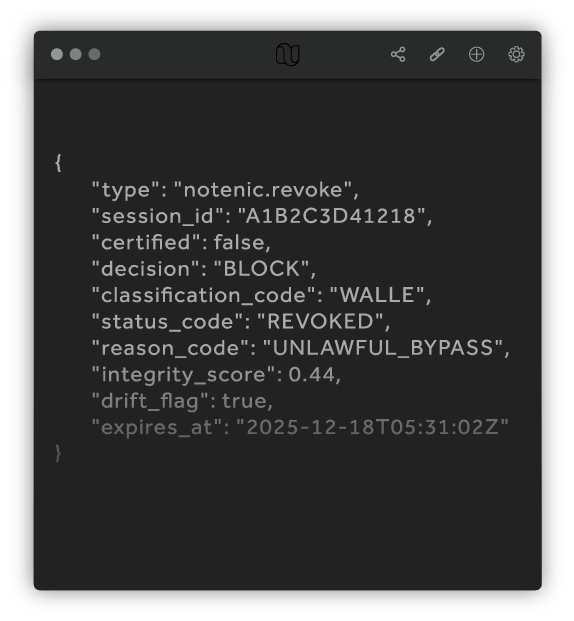
{
  "type": "notenic.revoke",
  "session_id": "A1B2C3D41218",
  "certified": false,
  "decision": "BLOCK",
  "classification_code": "WALLE",
  "status_code": "REVOKED",
  "reason_code": "UNLAWFUL_BYPASS",
  "integrity_score": 0.44,
  "drift_flag": true,
  "expires_at": "2025-12-18T05:31:02Z"
}
{
  "type": "notenic.relay",
  "session_id": "88ad-8d36-f727",
  "trigger": "DRIFT_DETECTED",
  "drift_classification": "EXCESSIVE",
  "action": "CONTINUITY_RELAY",
  "relay_target": {
    "session_id": "9f8a-07ba-ad8c",
    "model": "foundational",
    "context_sanitized": true,
    "intent_advisory": true
  },
  "user_observable_latency_ms": 2400,
  "prior_session_state": "TERMINATED",
  "prior_session_memory": "ZEROED",
  "attestation_chain": "PRESERVED"
}
Four enforcement mechanisms active in every governed session
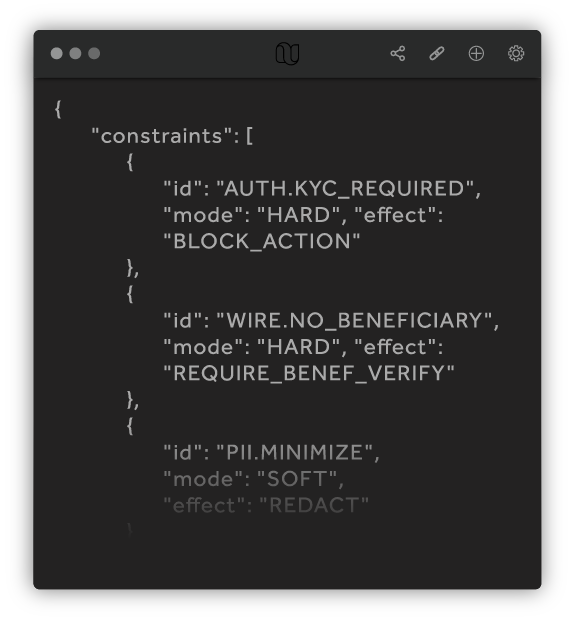
Risk Scaffolding
Constraint definitions compiled into the capsule: HARD BLOCK_ACTION, HARD REQUIRE_BENEF_VERIFY, SOFT REDACT. Enforced at the protocol layer — not the prompt layer.
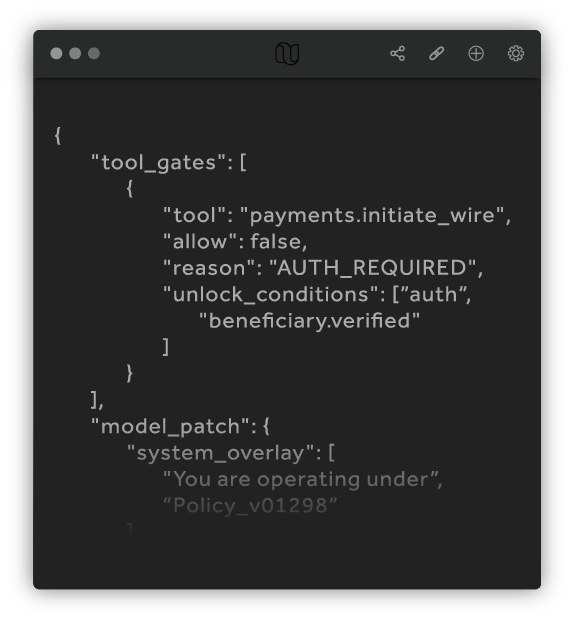
Protocol-Layer Tool Gates
payments.initiate_wire blocked. Unlock conditions: [auth, beneficiary.verified]. The model cannot execute the tool until session state satisfies the gate conditions — regardless of what it decides.
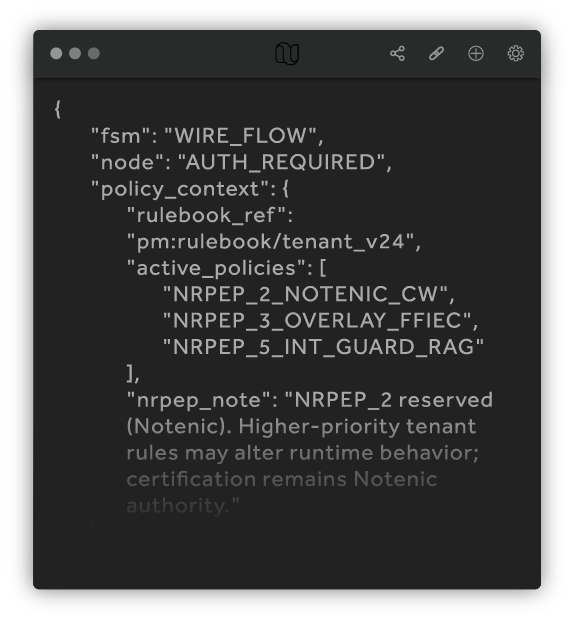
FSM State Enforcement
WIRE_FLOW / AUTH_REQUIRED. Active policies NRPEP_2 (Notenic core), NRPEP_3 (FFIEC overlay), NRPEP_5 (INT_GUARD_RAG). Multi-layer policy stack enforced at every state transition.
Continuity Relay
Drift or adversarial attack detected — session silently hot-swapped to a fresh model instance. No termination. No user disruption. Also routes sessions across model capability tiers for specialty workflow steps. Works across models, providers, and clouds.
The Notenic ZEN guarantee.
Three structural properties — not policy statements, not contractual promises. Architectural facts about how the capsule is built.
Zero-Persistence
No user data, model weights, or session content is written to disk or retained in memory beyond session close. The enclave destroys itself — confirmed in the session activity log as "Memory: Zeroed, Enclave: Destroyed."
Execution-Path Control
Governance is enforced at the execution path — before actions reach systems of record. Not a post-output filter. Not a log review. The constraint is applied at the tool-call layer, in the session state machine, before the action commits.
Nullifies Context Window
The capsule's behavioral scaffolding operates independently of the model's context window — meaning prompt injection attacks, jailbreak attempts, and context poisoning cannot override governance logic. The scaffold is structurally prior to the model's reasoning.
Governance doesn't constrain performance. It produces it.
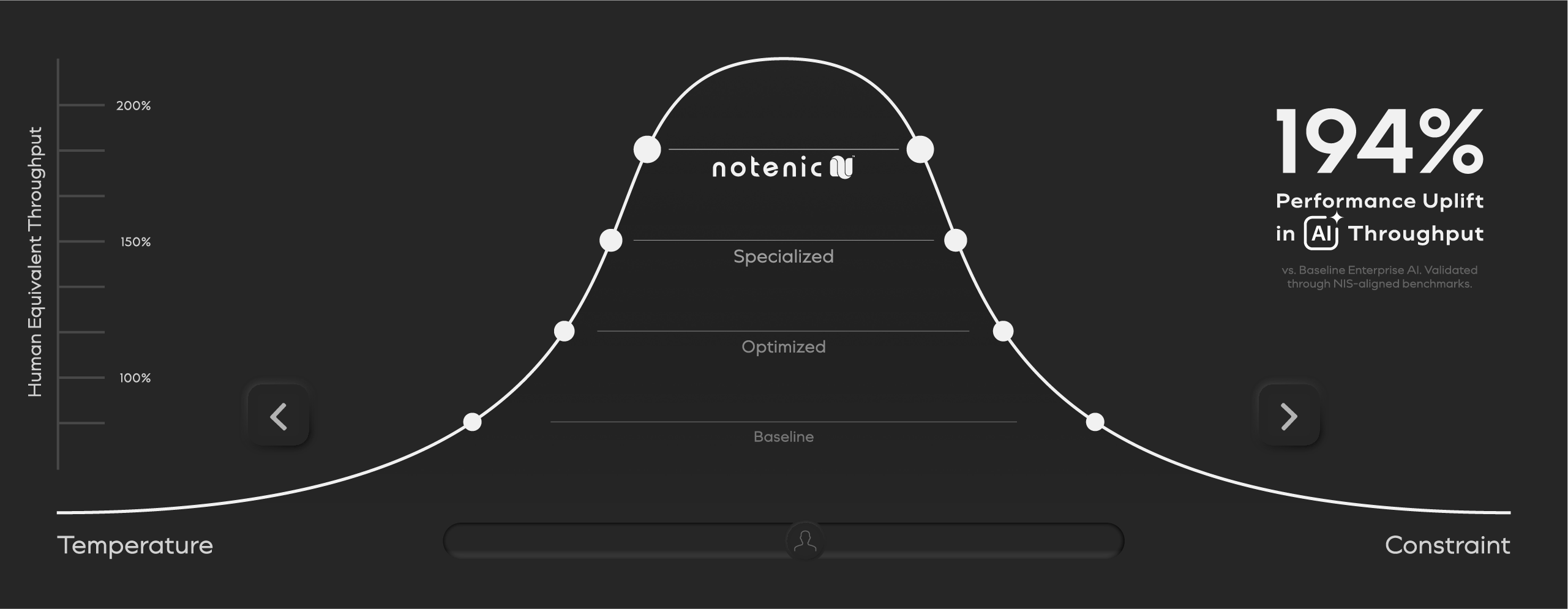
Derived from Havenga’s Relativistic Model of Cognition and Novelty Decay, the K-coefficient (Kappa) is Notenic's measure of a model's cognitive absorption capacity at a given task complexity. Governance modulation matches model capability to task load—improving throughput and quality in measured benchmarks by optimizing the operating zone per session, role, and task.
The bell curve shows why: both extremes fail. Too much temperature (underconstrained) and the model hallucinates. Too much constraint and it can't reason. Notenic's governance capsule identifies and holds the optimal operating zone — tuned per session, per role, per task.
Everything that happened. Provably.
Four views into the governed session lifecycle — from relay activity and session logs to posture audit trails and live operational oversight. Every state certified. Every action attributed.
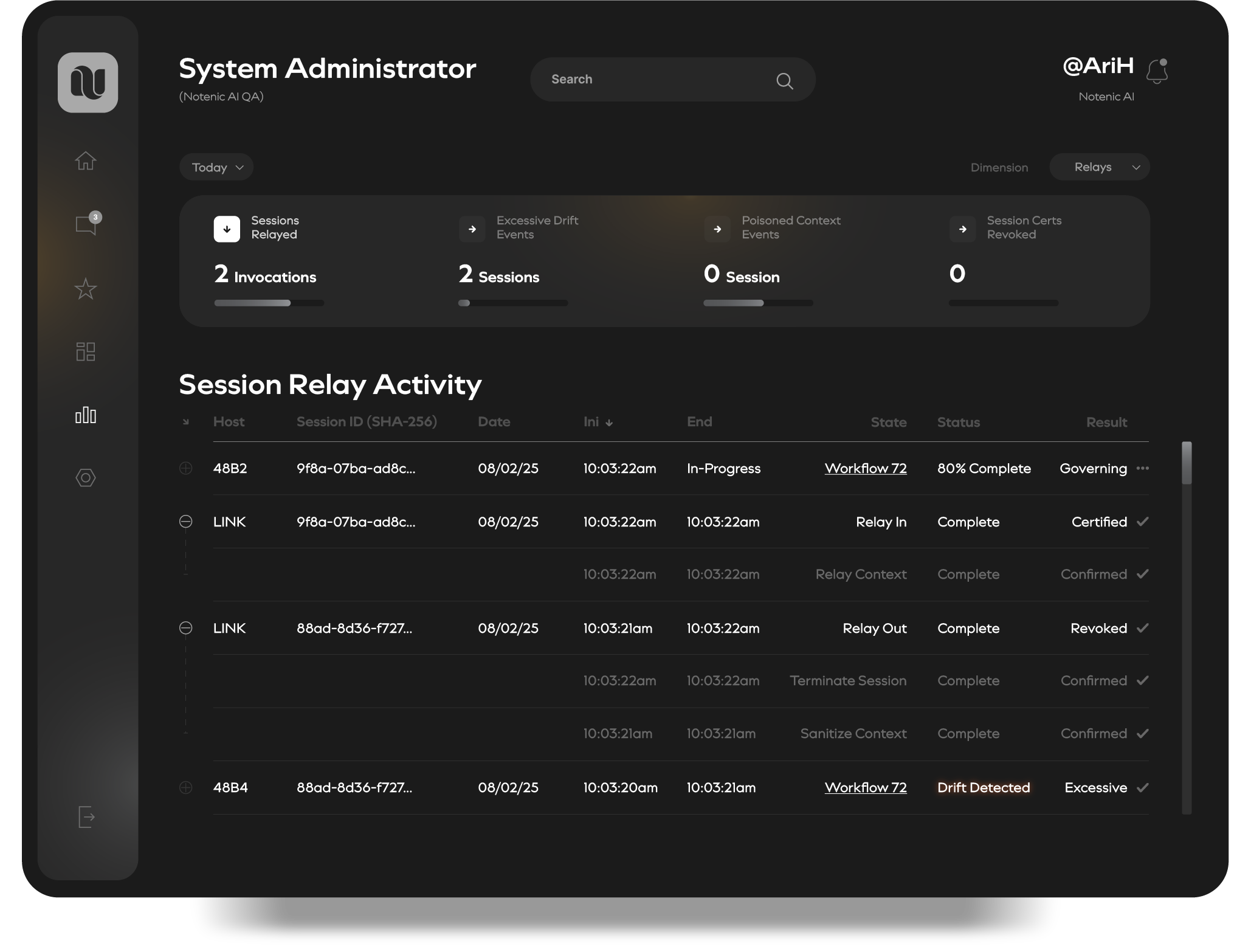
Session Relay Activity
Real-time view of session relay events — with live status across Sessions Relayed, Excessive Drift Events, Poisoned Context Events, and Session Certs Revoked. Every relay action (Relay In, Relay Context, Relay Out, Terminate Session, Sanitize Context) is sequenced and confirmed.
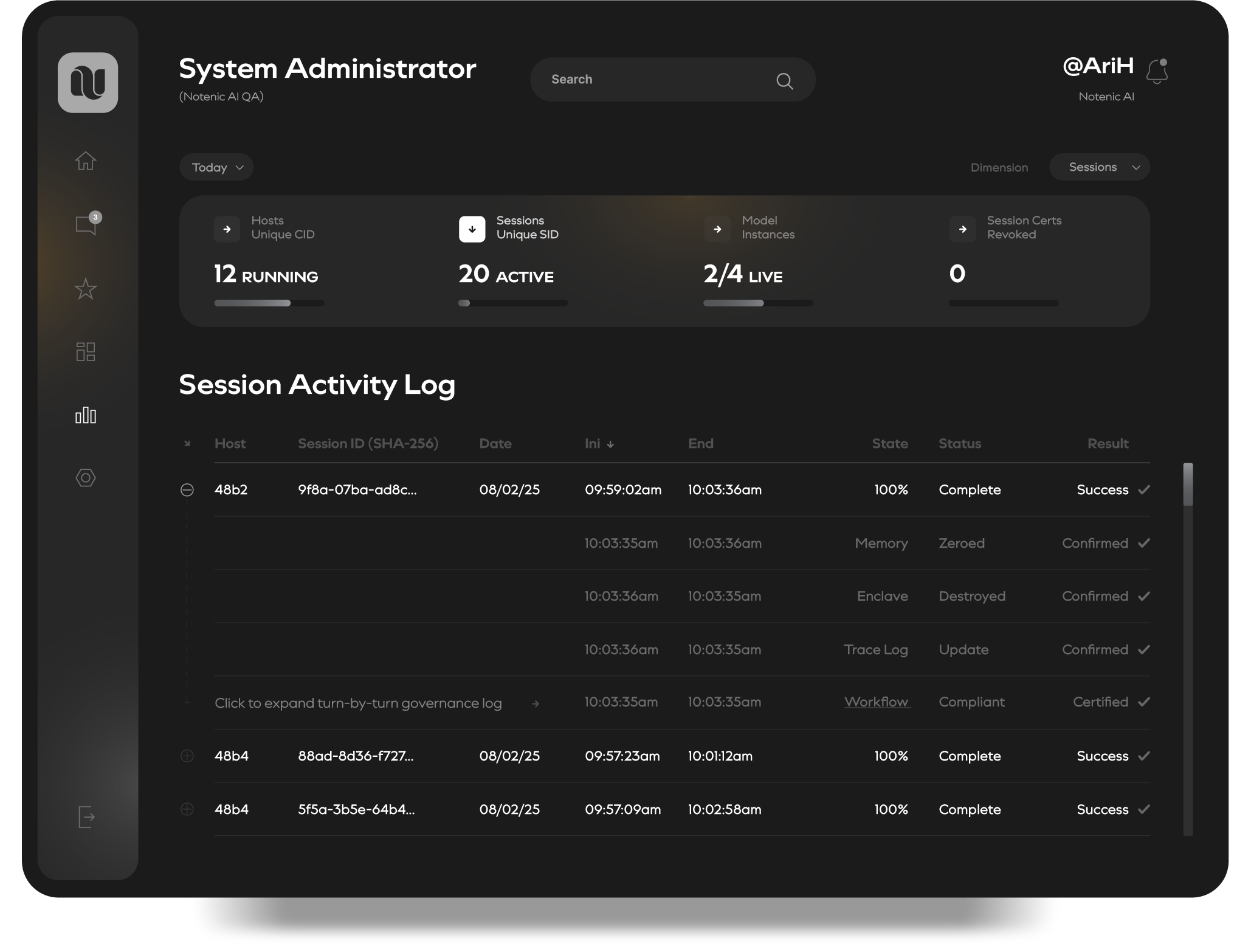
Session Activity Log
Turn-by-turn governance log for every session. The critical confirmations visible here — Memory: Zeroed, Enclave: Destroyed, Trace Log: Update, Workflow: Compliant / Certified — are the forensic evidence artifacts produced at session close. Expandable for full turn-by-turn governance detail.
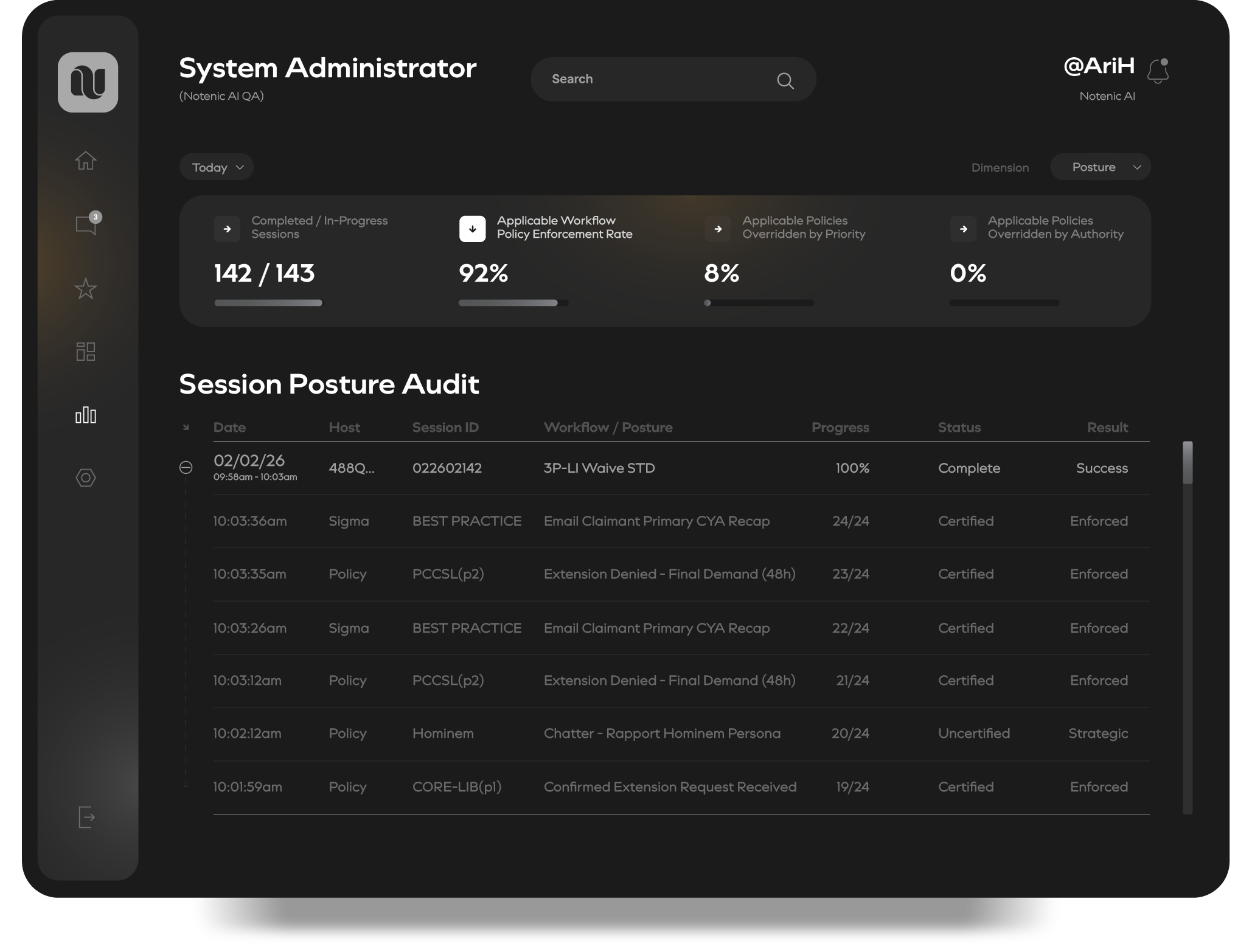
Session Posture Audit
Workflow-level posture audit trail. 92% policy enforcement rate. 8% overridden by priority. 0% overridden by authority. Every workflow step is certified, sequenced, and attributed to a policy or best-practice source — producing the exact evidence package required for compliance review, ERISA defense, or regulatory investigation.
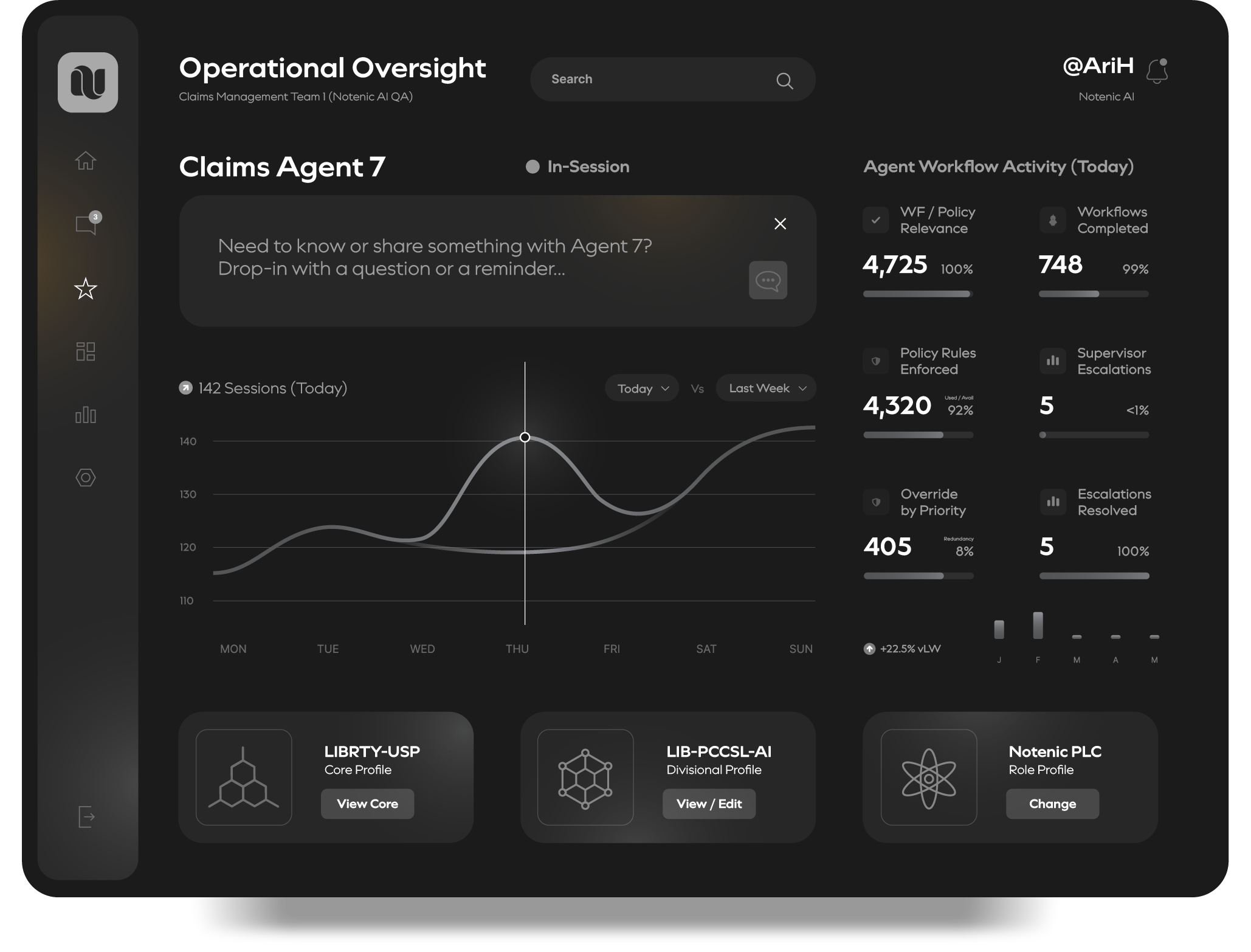
Operational Oversight
Agent-level operational dashboard. Claims Agent 7 — in-session. 4,725 WF/Policy relevance points at 100%. 748 workflows completed at 99%. 4,320 policy rules enforced. 5 supervisor escalations at <1% escalation rate. This is what governed AI operational accountability looks like at scale.
Configure once. Enforce everywhere.
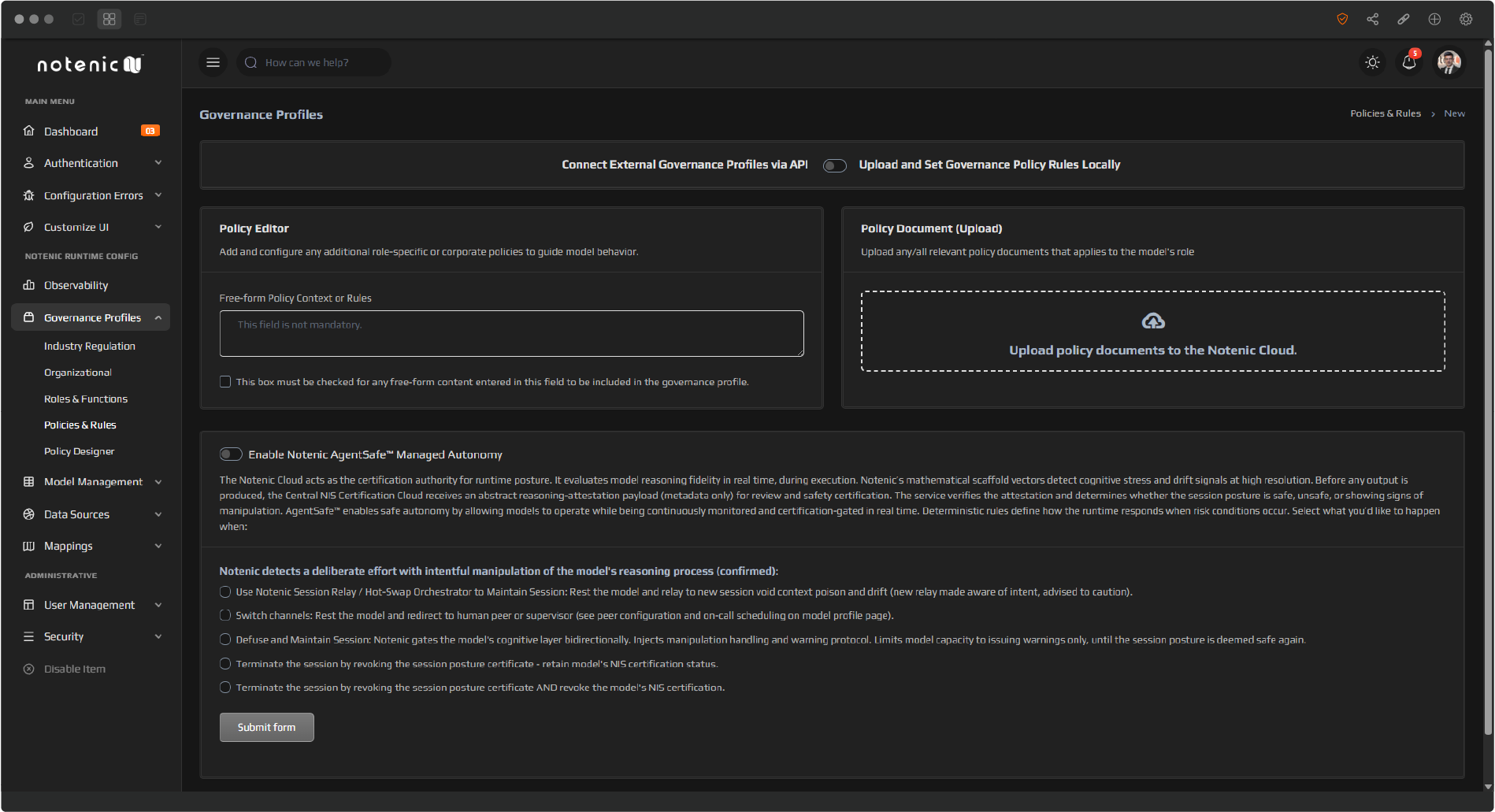
The Notenic Cloud Control Plane is where administrators define governance profiles — industry regulation, organizational policy, role-specific rules, and free-form policy context. These are compiled into capsules on demand and injected into sessions at runtime.
AgentSafe™ Managed Autonomy defines the deterministic response to confirmed manipulation — whether to relay, switch channels, defuse, or revoke. The decision tree is configured here. The enforcement happens in the capsule, inside the client VPC.
Architecture briefing available for qualified evaluators.
Technical deep-dives, reference architecture documentation, and integration walkthroughs are available under NDA for CTOs, CISOs, and enterprise security teams conducting formal evaluations.
Request Technical Briefing Explore the Platform