Notenic AI Orchestration Platform

Built for Agency & Enterprise Reality

Orchestrate, govern, and scale autonomous digital labor across enterprise environments — without compromising control, accountability, or operational integrity.

Enable decentralized agent management while maintaining consistent policy enforcement, system reliability, and verifiable execution across workflows.

Most platforms treat governance as a layer you add after deployment. Notenic treats it as infrastructure — compiled into the execution environment before your agents ever reach a system of record, and independently verifiable at every session boundary.

01

Empower business leaders

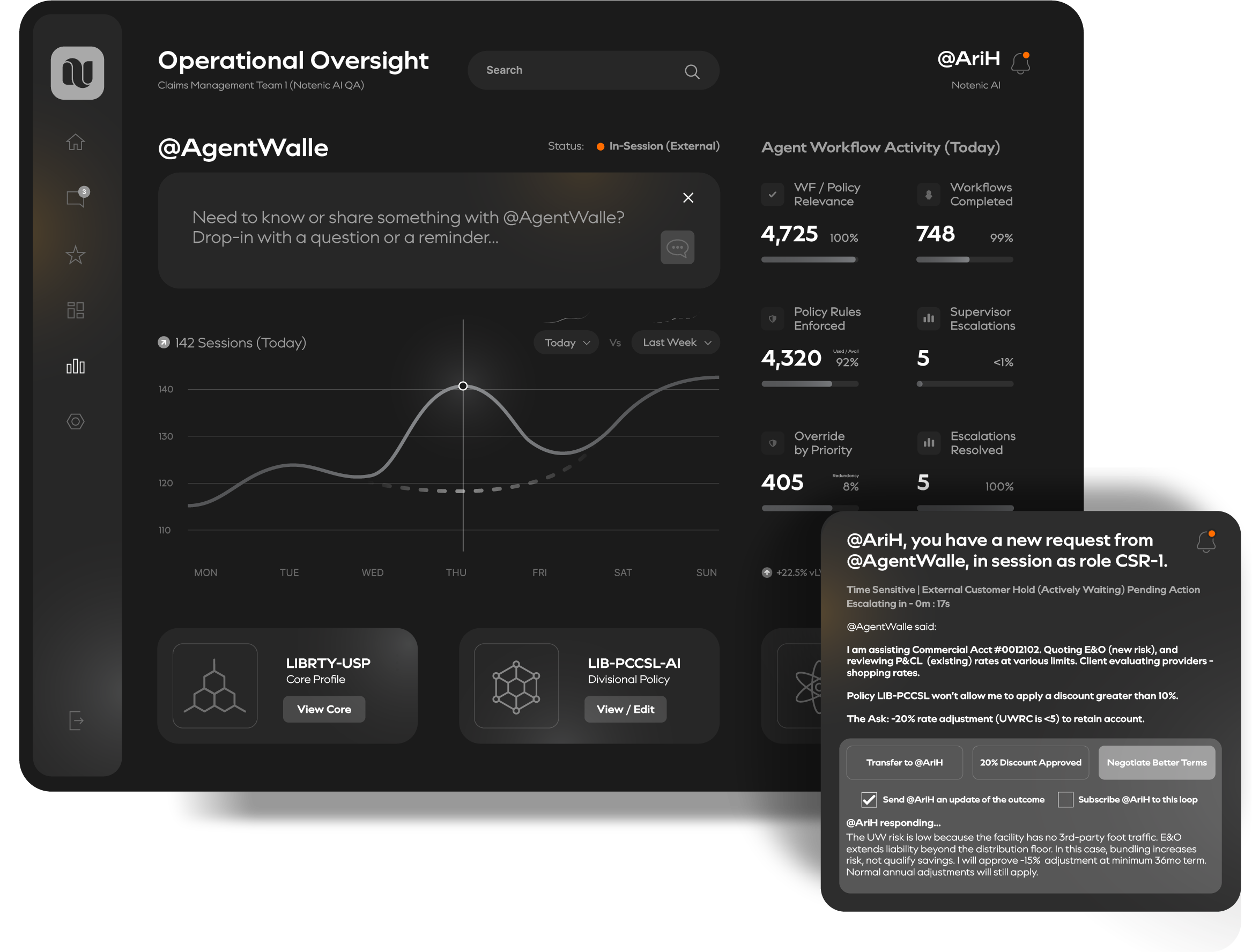
Define authority, delegate agency, and maintain ownership of workflow outcomes — without routing every change through an engineering team.

02

Enforce at the execution path

Zero-trust controls applied in-session — governing tool access, workflow state, and escalation before actions reach systems of record.

03

Prove every decision & action

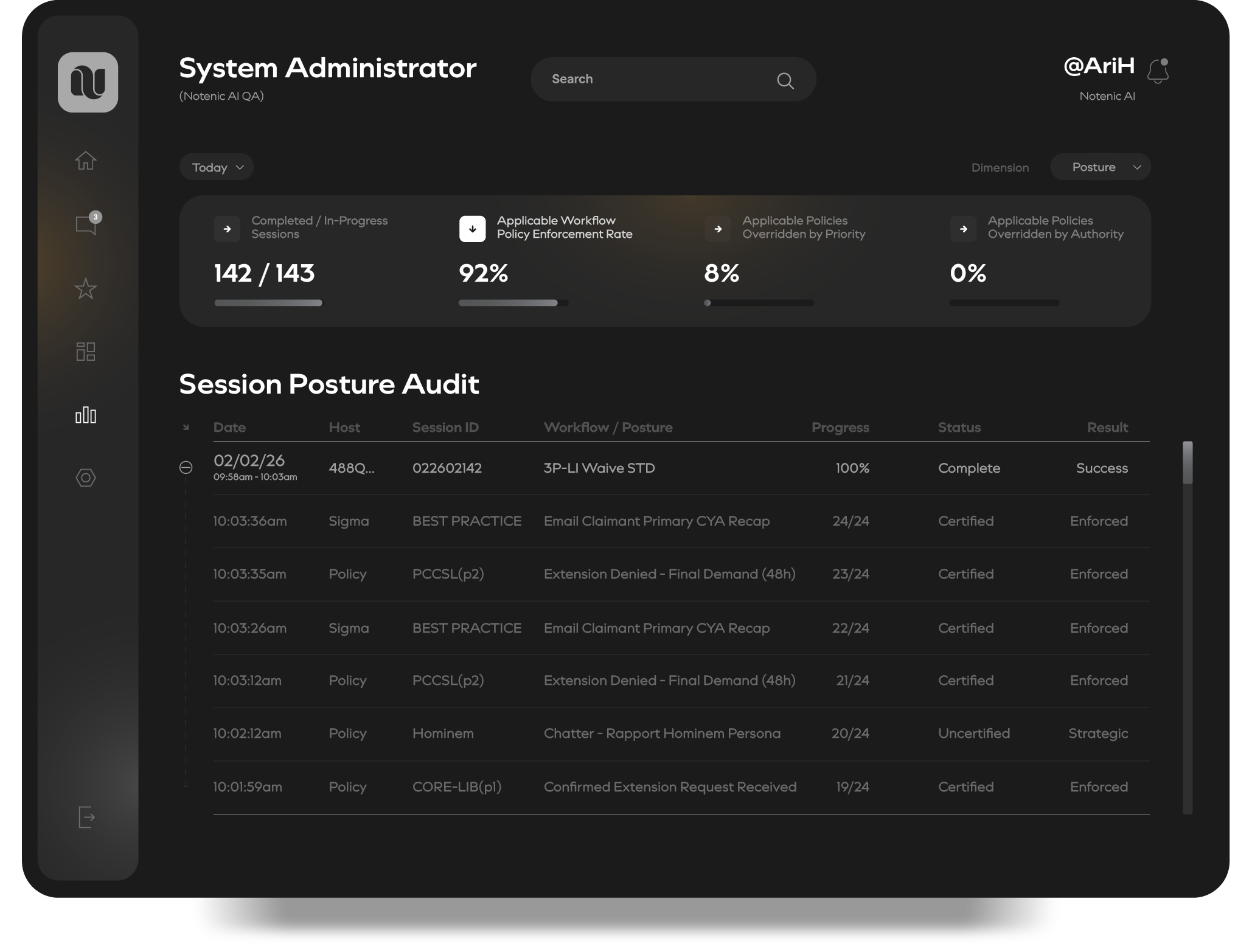
Stateful, verifiable posture evidence at the session level — built for audits, regulatory review, and compliance programs.

Operational Viability & Technical Solvency

Multi-modal by design. Portable across environments. Governable by construction. Notenic provides the operational foundation for organizations deploying AI at scale — where human and machine workforces must perform together, safely and accountably.

Built For

Modern Enterprise:

Maintain ownership of outcomes and operational performance.

Notenic separates day-to-day agent operations from engineering dependencies — enabling teams to manage digital labor with the same clarity and control as a human workforce. Business leaders define authority. They don't file tickets to exercise it.
  • Manage agents as operational units
  • Configure workflows and escalation paths
  • Publish SOPs and operational guidance
  • Supervise execution in real time
  • Monitor productivity and performance
See ROI by Vertical

Establish oversight, traceability, and audit readiness — at the session level.

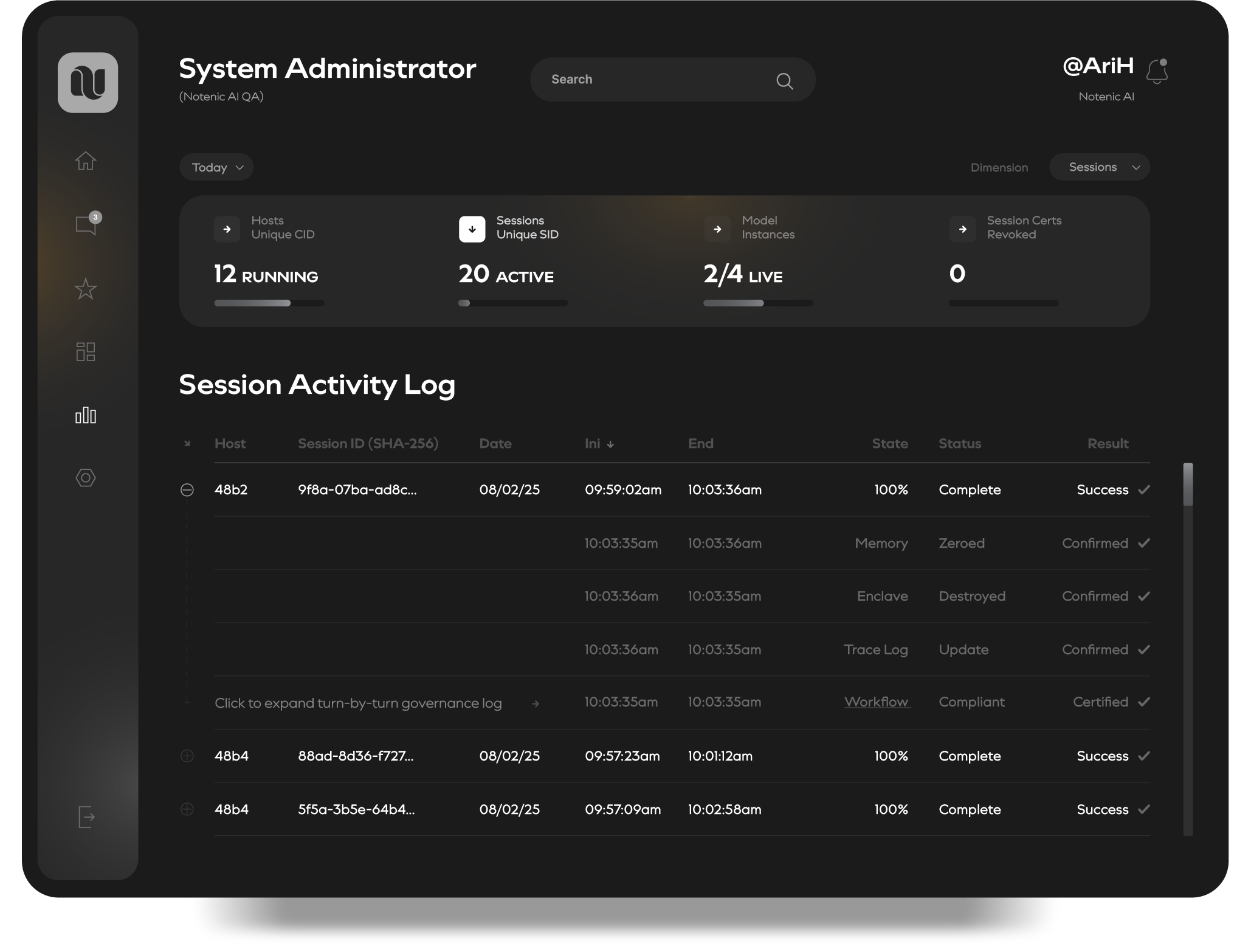
Notenic generates verifiable records of governed session activity, enabling traceability of automated decisions without requiring access to user content. Compliance posture is not asserted — it is evidenced, turn by turn, across every governed workflow.
  • Repeatable governance at scale
  • Persistent session posture records
  • Consistent role-aligned enforcement
  • In-boundary processing
  • Evidence aligned to SOC 2, ISO, HIPAA, GLBA, FFIEC
Request Governance Consultation

Deploy scalable, governed AI systems without governance becoming a DevOps tax.

Agentic workflows execute within session-bound environments designed to limit persistence and reduce data exposure. Built-in workflow continuity supports controlled transitions between execution contexts — maintaining alignment between task intent, system constraints, and governance requirements without manual intervention.
  • Strong data hygiene by design
  • Reduced state-dependent vulnerabilities
  • Constrained policy deviation during execution
  • Minimized operational attack surface
  • Decentralized ownership — less firefighting
Request Architecture Briefing

Notenic AI Platform Capabilities

Six capabilities. One control plane.

Consistent execution, operational reliability, and governance across distributed AI workflows — deployed through a unified control plane designed for enterprise-scale environments.

Decentralized Ownership

Control owners publish the rules they are accountable for. DevOps maintains the rails — it does not administer the workforce. Authority and operations are clearly separated.

On-Demand Policy

Publish policy updates, revised SOPs, and new tool permissions on demand. Notenic makes them enforceable immediately — no model retraining, no redeployment cycle.

Proactive Control

Controls applied during execution, before agentic actions are committed to systems of record. The governing decision happens at the point where it still matters — not in a review queue after the fact.

Compute Efficiency

Coordinate workflows across inference systems to optimize performance, latency, and cost efficiency. Governance overhead is designed to remain below 15ms in validated deployment conditions.

Stateful Auditability

Know what every agent did — and why it was permitted. Session posture records provide authorization evidence and enforcement traceability end-to-end.

Zero Data Retention

Reduce data exposure with ephemeral sessions and strict zero-persistence controls. User content does not persist beyond the active execution context under any condition.

Why Notenic Governs Differently

Governance that evaluates whether the model is ready for the task.

Most governance platforms evaluate what a model produced. Notenic's Cognitive Governance engine evaluates something prior to that: whether the model assigned to a given task has the cognitive capacity that task requires.

When a mismatch is detected, the platform can intervene before the session reaches a system of record. Developed in partnership with The Notenic Learning Institute for Applied Intelligence, the K-coefficient (Kappa) is the measure that makes this possible. Full technical specification, governance modulation model, and deployment benchmarks are available on the Architecture page and under NDA for qualified evaluators.

Notenic K-coefficient (Kappa)

Why Notenic

A structural approach to governance, independent of how the model was built.

Guardrails, agent orchestration, and context engineering each address governance partially and at significant ongoing cost. Notenic addresses it structurally — before the model acts, independent of how the model was built.

Notenic AI Governance and Orchestration Infrastructure
Pre-action enforcement Deterministic constraints enforced before agentic actions are committed to systems of record.
Independent from model weights Governance rules are portable — not coupled to any model, provider, or deployment.
Verifiable session-level evidence Every session produces a stateful audit record — what was authorized, why, and when.
Survives model provider change Platform is provider-agnostic — governance layer persists regardless of the underlying model.
On-demand policy updates Policy changes deploy immediately — no model retraining, no redeployment cycle.
Human-in-the-loop at tool level Protocol-enforced pause points at tool invocation — before execution, not after.
Guardrails + RAG
without Notenic
Partial. Guardrails can intercept but post-inference; RAG is retrieval only; filtering acts after output is generated.
Partial. Guardrails and filtering are external; RAG is retrieval-coupled and index-dependent per deployment.
Logs only. Violation and output logs exist; no verifiable authorization chain tied to enforcement decisions.
Framework is portable; RAG indexes must be rebuilt; filter rules need recalibration per model output behavior.
Guardrail rules and filters update independently; RAG requires re-indexing on knowledge or policy change.
No tool-level protocol enforcement — intervention occurs at output, not at the point of action.
01
Agent Orchestration
without Notenic
Partial. Orchestration adds routing logic but no true enforcement gate; observability is reactive by design.
Partial. Orchestration logic sits outside the model but is tightly coupled to workflow and tool design.
Traces Only. Observability tools produce execution traces; no session posture or authorization evidence record.
Orchestration logic transfers in principle; tool integrations and routing logic typically require significant rework.
Workflow and routing changes require redevelopment cycles as a DevOps maintenance function — no live policy layer.
Orchestration can insert human approval steps, but these steps are not protocol-enforced at the tool invocation layer.
02
Context Engineering
without Notenic
Obfuscated as governance — focused purely on model behavior. No enforcement architecture at any layer.
Behavior is either embedded in weights or bound to prompt structure. Portability is structurally impossible.
No evidence chain of any kind — no visibility into what the model did, or what it was or was not permitted to do.
Prompts require full rebuild; fine-tuned models cannot be migrated — models must be retrained from scratch.
Prompt revision is manual and inconsistent at scale; fine-tuning requires full redevelopment / retraining cycle.
No mechanism for tool-level human intervention — model executes without a governance checkpoint.
03
Agnostic by Design

Any model. Any cloud.One governance standard.

Deploy runtime governance across your full model stack from one centrally managed platform — keeping policy independent from model weights, and ownership of governance logic strictly yours.

In-Process
Runtime

Embedded Policy Enforcement

Governance logic operates within the application execution context, enabling low-latency enforcement and reducing dependency on external control layers.

Enterprise value: Low-latency execution · Designed for real-time and high-frequency agentic operations.

Local Sidecar
Service

Architecture-Agnostic Governance

Deploy governance as a local or adjacent service across diverse technology stacks — consistent control without requiring deep integration or wholesale re-architecture.

Enterprise value: Minimal disruption · Integrates with existing environments.

Policy Adapter
Layer

Existing Security Investment Alignment

Integrates with existing security controls and guardrails, enabling unified governance across systems without displacing prior investments..

Enterprise value: Low-latency execution · Designed for real-time and high-frequency agentic operations.

Featured

Enterprise Integrations

.
Natively Supported

Models & Compute

Platform access is included within Notenic services engagements. Standalone enterprise licensing is available for organisations deploying at scale — contact us to discuss.

Scroll